by Randolph B. Old
The world recently lost Dr. Pierre Bikai, meaning that the American Center of Research (ACOR) lost one of its exceptional former directors. Pierre served as director from 1991 to 2006, some 20 years ago, and his time at ACOR needs to be remembered and applauded.
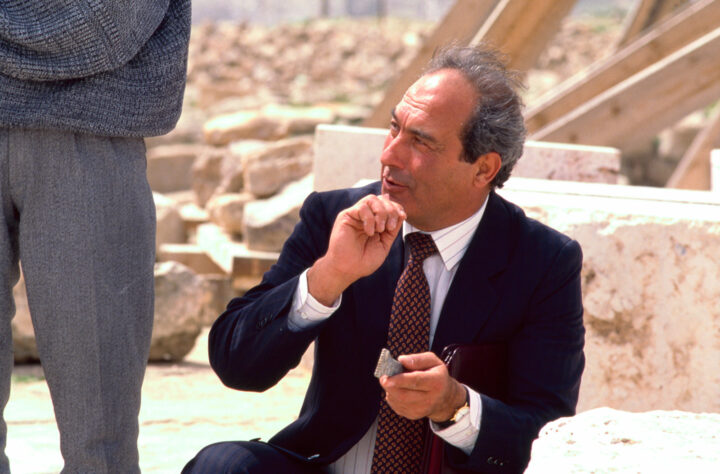
ACOR advertised the director position in 1990, and Pierre was one of the strongest candidates. He was somewhat controversial, however, as he was Lebanese, he had not finished his PhD, and his resume did not demonstrate nonprofit management experience. The board, deciding who would become the next director, wondered whether his Lebanese nationality would be a handicap when dealing with the Jordanian Minister of Antiquities or the U.S. Embassy, organizations on which ACOR depended. Importantly, ACOR, like most nonprofits, always lived from hand-to-mouth, and raising money was a constant part of the director’s job; could he manage ACOR and raise the necessary funds to keep it going?
His archaeological experience was sound, as he had worked on successful excavations at Tyre in Lebanon and was a few months away from finishing his PhD on reading and dating tree-growth rings (dendrochronology), a skill that would be helpful in Jordan. He was also married to an archaeologist named Patricia, a steady, bright, and detail-oriented person. The board finally agreed to hire Pierre, noting that his Arabic was a plus; the community advised that being Lebanese was not a negative, and that the combination of Pierre and Patricia was a strong addition to ACOR.
At the same time, a new president was appointed to ACOR’s board: Dr. James Sauer, a superb archaeologist, a past ACOR director, and a man well known to the community. Unfortunately, in the first few months after the arrival of the Bikais at ACOR, it became clear that Dr. Sauer had a degenerative disease that required him to step down, which prompted a search for a new president. Pierre’s first major contribution to ACOR was to convince Artemis Joukowsky to become president. Artemis had been a long-term friend of his, a co-excavator in Tyre, and a witness to his marriage to Patricia, also in Tyre. It did not happen quickly, as Artemis wanted to understand ACOR’s mission before accepting the job, so a group effort quickly produced a fitting mission statement. This was a major accomplishment because Mr. Joukowsky was an experienced board chair, Chancellor Emeritus of Brown University, a successful businessman, and someone who then attracted many talented, bright people to ACOR’s board. These new members brought deep legal, financial, and archaeological expertise to a board that benefited immediately. Terry Christensen, a well-known lawyer from New York, rewrote or updated all ACOR’s legal documents, and Bill Bardel handled ACOR’s investment strategy. Jim Wiseman, head of the Boston University Department of Archaeology, added experience to the board. The board grew, and its makeup became one-third archaeologists, one-third Jordanian members, and one-third lay members. Additionally, Artemis’s wife, noted archaeologist Martha Joukowsky, joined as part of the package and undertook excavations at Petra’s Great Temple for about 20 years.
Pierre led several major projects that ACOR undertook during his fifteen years as director: the column restoration on the Amman Citadel (Fig. 1), the development of the Madaba Archaeological Park, the Petra Church excavation and the discovery of the papyri there, the excavations of the Ridge Church and the Blue Chapel, the expansion of the ACOR building, and the creation of JADIS, a database for documenting sites in Jordan. The digs were usually designed, directed, and administered by seasoned archaeologists, with ACOR often arranging for funding, housing, licenses and visas. Patricia Bikai, while assistant director, headed several excavations.
Leading up to the arrival of the Bikais at ACOR, finances had always been difficult. The Joukowsky Foundation, the new board members, and several outside donors began an endowment that reached five million dollars during Pierre’s term as director, a significant contribution to ACOR’s stability. A major part of the endowment resulted from Pierre convincing USAID to contribute funds that they had intended for tourism development in Jordan but had gone unused; those funds went instead to ACOR’s endowment, which indirectly aids tourism. The event made the news with a striking picture of Hillary Clinton in Petra holding a large version of the check, made out to ACOR.
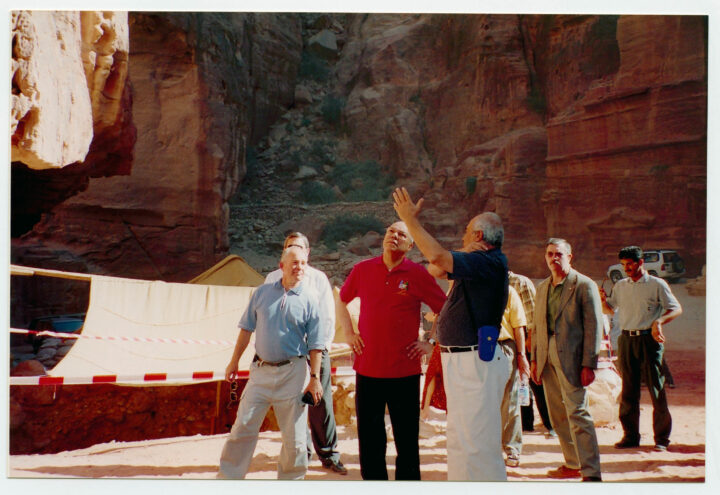
While there were significant accomplishments during Pierre’s directorship, there was also much camaraderie and fun, as both Pierre and Patricia had good senses of humor and were dedicated to the friends, staff, and mission of ACOR. Pierre led many tours around Jordan, breaking out in his strong baritone voice upon entering a building or temple. He was famous for his sandwiches and started a small store selling rugs, keffiyehs, and jewelry at ACOR (proceeds to ACOR). He always wanted to know how much was in the “tomato drawer,” a term left over from his experience growing tomatoes in Lebanon, referring to the remaining funds after all income and expenses were accounted for. Also interesting was Patricia and Pierre’s “Dip Dig” program, which was a several-year program they ran for lay people to join an excavation. Women and men from the local and diplomatic communities learned as they went, made some significant finds, and benefited greatly from the experience. It was a novel idea, and one well received by the participants.
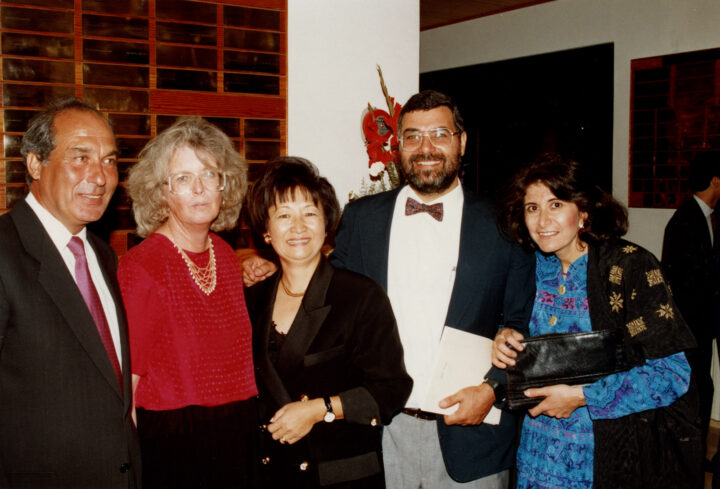
The major accomplishments that were to come from Pierre’s directorship were not at all evident at the time he was originally interviewed. He arrived at ACOR when it was financially struggling and governed by a passionate but inexperienced board, and he left ACOR financially strong and well-governed, after accomplishing several major projects that enhanced tourism for the country. It was not only Pierre; the teamwork of Patricia and Pierre was the magic that made it happen, along with the support and guidance of an experienced board.
Randolph B. Old’s family moved to Jordan to open a branch of Chase Bank in 1975, and he now considers Jordan a second home. After arriving in Jordan, the Old family was quick to become involved in ACOR through Friday field trips, pottery classes, and hand-ax hunts. Mr. Old joined the board in 1990, became treasurer in 1992, and served as president of the board from 2011 to 2019. Throughout his involvement, he has witnessed the American Center move from a small rented office on Amman’s 3rd Circle to its permanent building in the city’s Tla’a al-Ali District, complete with an extensive research library. The American Center of Research has been an important part of life for Mr. Old and his family, and his wish is that it continue to be an inspiration for students and productive partner for the Jordanian government and educational institutions.