Welcome to Insights! Formerly our long-running quarterly e-update, since 2020, Insights has been our blog, hosting essays by fellows, interns, staff, and others.
Insights
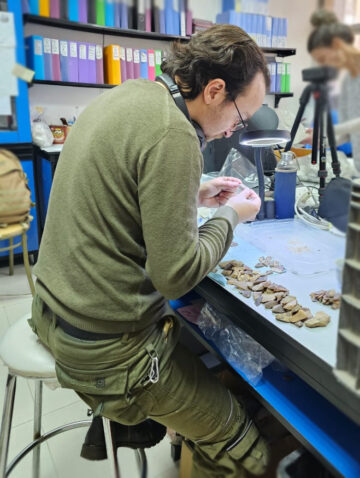
Science Without Borders: Overcoming Hurdles to Protect the Identity of Jordan’s Ancient Coins
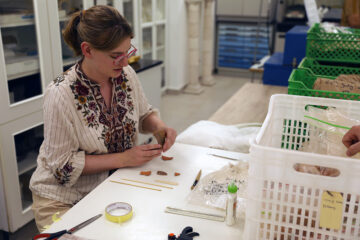
by Mohammad Rababah My journey with archaeology began not in a high-tech laboratory, but in the red dust of Jordan’s ancient sites. As a student at Yarmouk University and later as a field archaeologist, I spent years unearthing the tangible remains of our past, working on projects that stretched from the Roman aqueducts of Gadara…
Stone Tools on Repeat: Exploring Prehistoric Recycling Practices
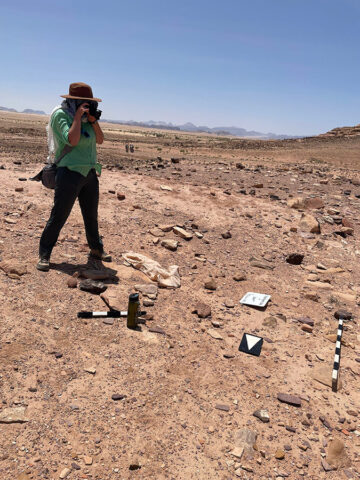
by Osama Samawi During my time as an undergraduate, I enrolled in a course called “Technology in Prehistoric Periods.” At 19, the word “technology” still made me think of computers, but I signed up out of curiosity. Prof. Maysoon Al-Nahar introduced us to the fascinating world of stone tool technology using Neolithic assemblages from Tell…
Under the Jordanian Sun: Summary Reflections of a Student Archaeologist at the Humayma Archaeological Field School
by Rachel Carroll Prior to this field school, my only archaeological experience and exposure came from classes I had taken at the University of Alberta, volunteer work I had done with one of my professors, and travels I had taken with my family. Never once had I stepped foot on a site intending to contribute…
The Midianite-Kenite Hypothesis and the Qurʾan: A Salute to ACOR
by Kareem Rosshandler I had the privilege of staying at the American Center of Research during the months of May, June, and July of 2025 and conducting research on depictions of Midian/Madyan in the Hebrew Bible and the Qur’an. Historically, Midian/Madyan is believed to have been located in the northwestern Arabian Peninsula, with its northernmost…
Terracotta Male Figurines from Iron Age Jordan
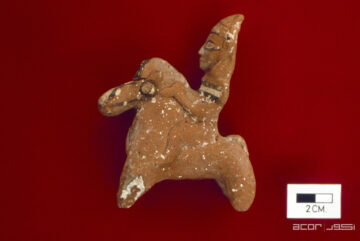
by Joel S. Burnett When it comes to understanding religion in Iron Age Jordan (ca. 1200–550 BCE), terracotta figurines offer one of our most abundant and expressive forms of archaeological evidence. These three-dimensional artistic objects fit readily into one hand (typically 10–15 cm), apparently crafted for personal use. At the same time, they appear across…
ACOR Internship Experience: Preserving Jordan’s Heritage: My Experience with ACOR’s National Inventory Project
by Roma Aatifi As an intern with the American Center of Research (ACOR) from September to October 2024, I had the opportunity to contribute to the National Cultural Heritage Property Database of The Kingdom of Jordan, an initiative to preserve Jordan’s cultural heritage. Known less formally as the National Inventory Project, it centers around creating…
ACOR Internship Experience: My American Center of Research Internship
by Zain Fanik I completed an internship at the American Center of Research over the course of two weeks during December, 2024. It was a great and very valuable experience, as I was able to work with archival documentation, as well delve briefly into cultural heritage databases. What I gained the most from this experience…
Dating Fatimid and Ayyubid Manuscript Fragments through Handwriting and Material Analysis
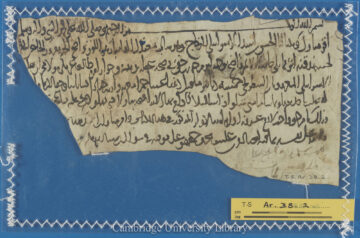
by Sarah Islam For historians of the Middle East, medieval documents and manuscripts are integral resources to better understand the social and intellectual milieu of their objects of study. Islamic manuscript archives and repositories are often quite challenging to access; an even greater challenge is the ability to read and analyze the documents themselves. For…
ACOR Internship Experience: In the Library with Rare Books and Maps
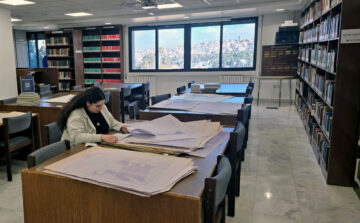
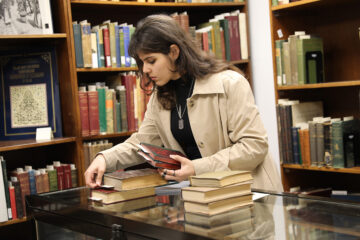
by Dima Nafez Amin Harb My name is Dima Nafez Amin Harb, and I am a cultural resources management and conservation graduate from the University of Jordan, the valedictorian of my major. Throughout my education, my professors would always recommend several organizations that could assist us with our study, and the American Center of Research…
ACOR Internship Experience: The National Inventory Project
by Madeleine Tripp From August 1 to September 12, 2024, I had the fortunate opportunity to undertake an internship at the American Center of Research (ACOR) in Amman, Jordan. I worked with the National Cultural Heritage Property Database of The Kingdom of Jordan project, known informally as the National Inventory. While currently training to be…
Together with ACOR: Fifty Years of Cooperation
by Zeidan Kafafi, Professor Emeritus, Yarmouk University The Beginning In the academic year 1967–1968 I enrolled as a student at the Department of History and Archaeology at the University of Jordan. Unfortunately, in that same period the Arab-Israeli Six Days War began on June 5, 1967. As a result of the war, in 1968 the…
Joining the 2024 Study Season at Khirbet al-Mukhayyat
by Nina Rozic This year I was able to participate in the study season for the Khirbet al-Muhkayyat Project, along with Kathleen Macleod Kerr, a fellow undergraduate student from Wilfrid Laurier University. We were delighted to return to the dig house in Madaba where we had stayed in 2023 while completing the field-school credit for…
How Regional Dynamics Impact Domestic Politics: The Case of Fuel Subsidy Reform in Jordan
by Molly Hickey Addressing the cost of fuel subsidies is one of the most politically challenging reforms a government can attempt. While subsidies pose a heavy burden on budgets and tend to accrue benefits toward the wealthy, they are quite popular with a large segment of the population, as they serve as a key supplement…
The Early Bronze Age IV Cultic Complex at Khirbat Iskandar
by Suzanne Richard My ACOR-CAORC Postdoctoral Fellowship, which I undertook in spring 2024, focused on the preparation of an upcoming volume entitled Archaeological Expedition to Khirbat Iskandar and Its Environs, Vol. 2: Final Report on the Early Bronze IV Area B Settlements. The goal was to revise several chapters, one being a field report on one…