by Miya Pletsas
This summer, I was given the opportunity to go back to Jordan to participate in the Khirbat al-Mukhayyat Archaeological Project survey season. During my time in Jordan, the team surveyed four sites around Khirbat al-Mukhayyat. The goal for this season was to collect data from surface collection, map architecture, and take measurements of various features, such as the dolmens. Students participated in all aspects of the survey, which included setting up the excavation squares, using the real-time kinematic (RTK) GPS, and collecting pottery. During lab time, students washed pottery, analyzed the artifacts, and drew pottery. The administrative tasks included entering data, taking photos, and organizing files.
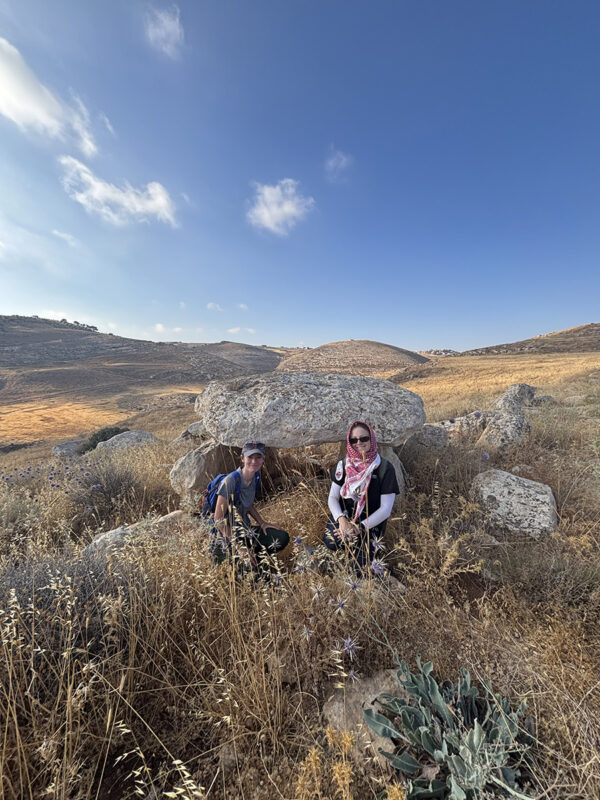
My favorite sites were Khirbat al-Mukhayyat and the Jadid Dolmen Field (Fig. 1). At Khirbat al-Mukhayyat, we focused on the Byzantine village. I had a wonderful time with my peers exploring the sites and collecting data. At the Jadid Dolmen Field, we were able to see intact and partially intact dolmens. Learning more about their importance to the area and the way they were constructed was fascinating. Once the data were collected, charts, maps, and movable images came together very nicely. Both sites provided useful data for future research. Overall, surveying provided me with a better understanding of these sites and their importance during times of change throughout the different periods in the Madaba region.
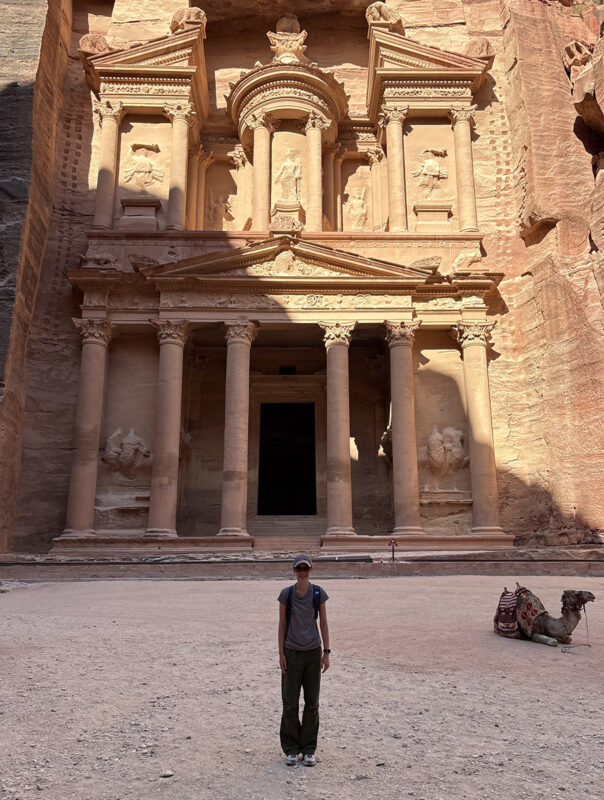
We also had the chance to revisit some archaeological sites and see some new spots, such as Wadi Mujib. Wadi Mujib was an exciting activity as we hiked and floated our way throughout the park. A group of us also went to Amman for the day to watch the new movie version of the Odyssey, and we all enjoyed that cinematic experience. We went to Petra and Wadi Rum; Petra is one of my favorite places to visit, and this time a couple of us took a new route to see the Treasury (Al-Khazneh) (Fig. 2) from a higher vantage point. Visiting Wadi Rum was also remarkable. We stayed in bubble tents and stargazed for a portion of the night. Overall, we were able to visit some new places, try some new food, and regularly enjoy Madaba.
During my time in Jordan, we were based in Madaba. Having the opportunity to be back and seeing familiar faces was comforting because these daily interactions at restaurants, grocery stores, and shops make our time here very enjoyable. It was especially fun to be in the country while the FIFA World Cup (football, or soccer for the U.S. audience) was on, as Jordan was a participating country. My peers and I had the chance to cheer for Jordan and see the community come together to watch multiple games.
The survey season was very successful, as the data showed how the pottery was distributed throughout the sites. The qualitative and quantitative data will help the team gain a more accurate understanding of site activity. These patterns will determine the next steps in the project’s research and documentation of these sites. I had a memorable time learning from the KMAP team and being back with my friends from my undergraduate experience in Jordan. The opportunity to learn from new peers, who are currently pursuing their PhDs, was a formative experience, as they provided me with valuable advice for my future studies.
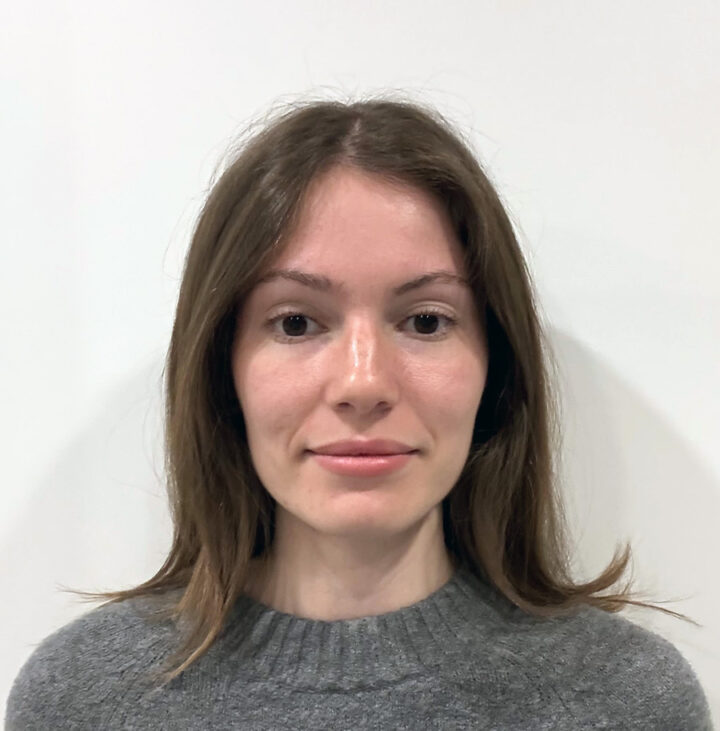
Miya Pletsas, the 2026–2027 Burton MacDonald and Rosemarie Sampson Fellow, will attend the University of Toronto in fall 2026 to pursue her MA in Near and Middle Eastern civilizations. She recently completed her undergraduate degree at Wilfrid Laurier University and is excited to continue her studies in archaeology. Since her last visit to Jordan, she has taken on new roles, including Near Eastern laboratory technician and instructional assistant at Wilfrid Laurier University. During her undergraduate education, she learned how to digitize pottery and taught first-year students skills that would help them complete lab work in the field. She is excited to gain more experience in the field and learn more from her professors and the KMAP staff.