by Kristen Flake
The Church of Sts. Lot and Procopius sits on the acropolis of ancient Khirbet al-Mukhayyat, overlooking the Dead Sea. Its 6th-century mosaic pavement is one of the best preserved in the region, covering the nave floor with the motifs typical of late antique Jordan: hunters and shepherds, vine scrolls filled with birds and animals, and Nilotic scenes of boats and fishermen (Fig. 1). These motifs have been documented and cataloged for decades. My dissertation research looks at them differently, not motif by motif, but as a single, coordinated visual program, and asks what that program meant to the people who worshipped in this space.
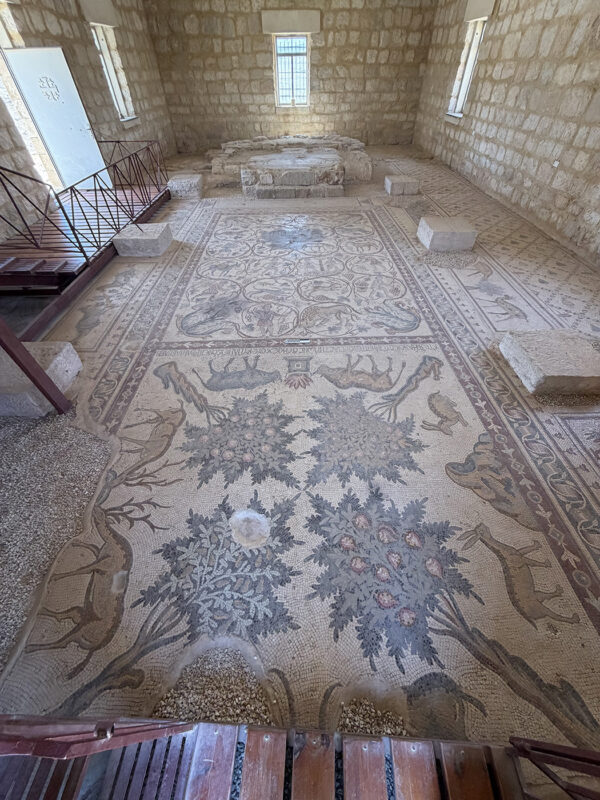
I have been studying the Church of Sts. Lot and Procopius for several years now. What first drew me to this particular pavement was the quality of its preservation and its elaborate inhabited vine-scroll motif, filled with the familiar hunting, vintaging, and pastoral scenes found across the region. After writing several papers on the inhabited vine-scroll motif, I noticed that scholarship tended to treat these images individually rather than as a collection embedded within a specific architectural and liturgical setting. I had also begun to notice how the same motifs appear in both secular and religious spaces, which raised a real question: are these common images are simply decoration or do they carry a more complex meaning depending on where they are placed? That question is what led me to study the visual and spatial relationships among the motifs within the pavement as a whole, examining the mosaics in context to understand both their significance and how the people who once worshipped here would have interacted with them.
Testing that idea meant spending a few weeks in June and July in Jordan doing something a dissertation cannot do from a library carrel. I needed to walk the church pavement repeatedly, tracking sightlines and thresholds. With support from ACOR’s Bert and Sally de Vries Fellowship, I was able to pair that fieldwork with LiDAR scanning of the church, generating a precise three-dimensional record of the nave that I can now use to model exactly what a worshipper standing at the entrance, or at the chancel screen, would have been able to see. This work produces a measurable record of how the space was experienced, not merely decorated.
This research extends beyond a single church. Madaba is called the City of Mosaics for good reason, and the surrounding region of Mount Nebo, Umm ar-Rasas, and Madaba’s own buildings preserve one of the densest concentrations of Byzantine floor mosaics anywhere in the world. Photographing the majority of the 6th- and 7th-century structures in the area gave me the comparative material needed to address a larger question of whether the visual program at Sts. Lot and Procopius reflects a shared workshop tradition passed among mosaicists working across the region or whether its expression seemingly linked to the psalms is unique to this particular church.
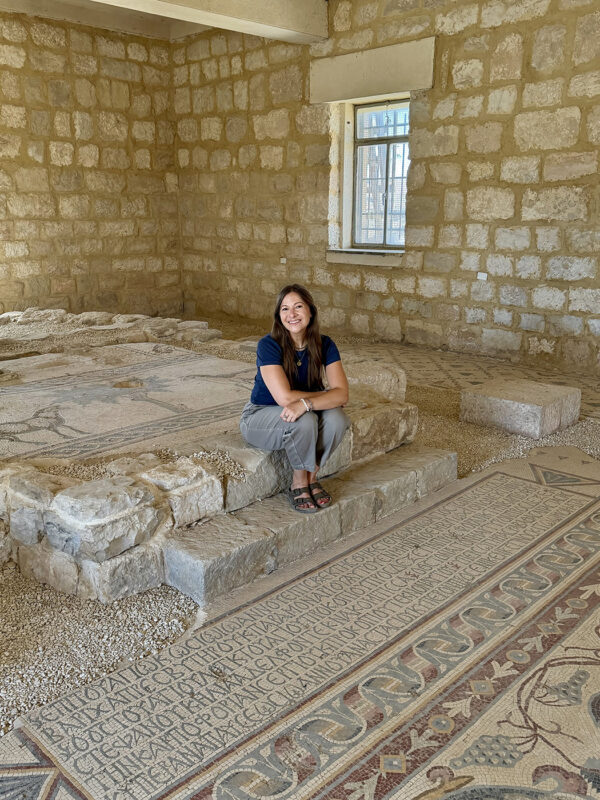
Not all of the most valuable time was spent inside a church, however. I spent the season based in Madaba with the Town of Nebo/Khirbet al-Mukhayyat Project, hosted by the project’s director, Dr. Debra Foran, and assisted with pottery analysis from the site alongside the team. A research visit to ACOR’s library in Amman provided access to excavation reports and many of Michele Piccirillo’s publications, which are essential sources for this work. And staying in Madaba itself, where mosaic-making is not only an ancient memory but a craft still taught and practiced today, gave me a fuller sense of what these pavements mean to the people who live alongside them now, not only to the 6th-century congregations who once walked across them (Fig. 2).
It is tempting, in a project such as this, to want LiDAR data from every church in the region. I began with that ambition, and then scaled it back part way through the season. The visibility analysis at the center of this project depends on focused, repeated work at the Church of Sts. Lot and Procopius, my primary case study; the churches I was only able to photograph still provided the comparative material I needed. In the end, this proved a more effective use of a short season than attempting a little of everything at every site.
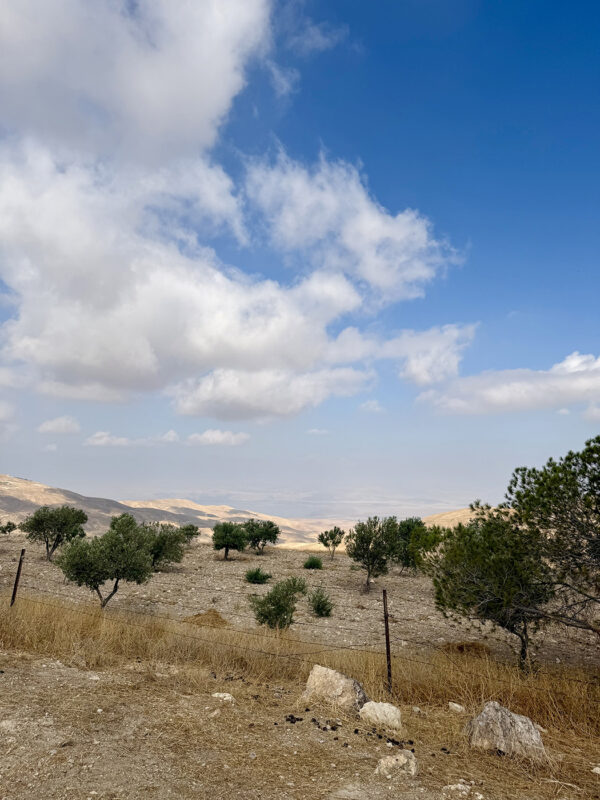
What has stayed with me most, however, is not the scan data. It is standing in the nave in the early morning light, watching the mosaic’s hunters, vines, and boats catch the sun exactly where a 6th-century worshipper would have stood to see them. It served as a reminder that the question I came to Jordan to ask is ultimately a question about how people and material culture, then and now, interact and experience sacred spaces (Fig. 3).
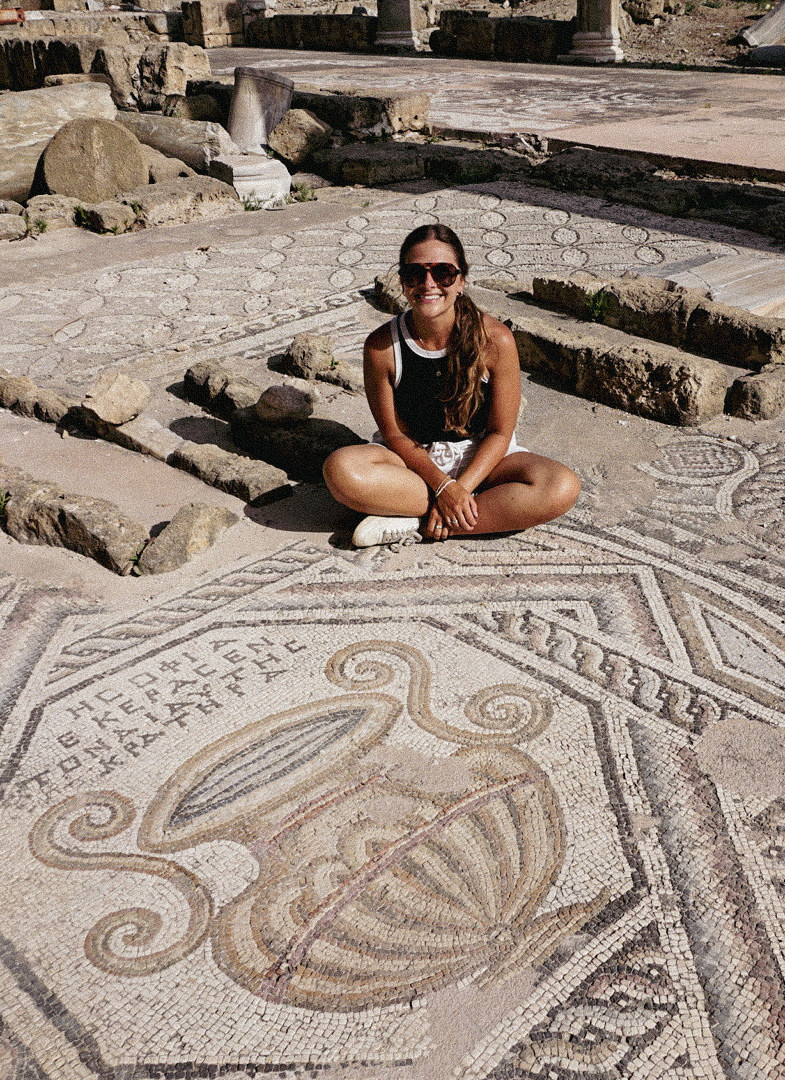
Kristen Flake is a PhD candidate in archaeology at Lipscomb University and the recipient of the 2026–2027 Bert and Sally de Vries Fellowship. Her doctoral research examines late antique church mosaic pavements in Jordan through an integrated archaeological, spatial, and liturgical framework. Her work explores how mosaic programs function within sacred space, with particular attention to the relationship between visual imagery, movement through the built environment, and early Christian worship practices. Kristen holds a master of arts in archaeology and biblical studies from Southwestern Baptist Theological Seminary and a bachelor of arts in ancient studies from Nelson University. She has participated in multiple archaeological excavations across the eastern Mediterranean including fieldwork involving the excavation and documentation of mosaic pavements. Her research interests include late antique Christianity, mosaic production and worship practices, and the intersection of liturgy, text, and material culture in the built environment.